Introduction: The Operational Challenge of Monolith Migration
Migrating a legacy monolithic application—one where business logic, data access, and user interfaces are tightly coupled—can feel like replacing the engine of a moving vehicle. The stakes are high: business continuity, data integrity, and stakeholder trust all depend on a smooth transition. Yet, with careful planning and the right technical strategies, it’s possible to modernize a monolith while minimizing operational risk.
Why Low-Risk Migration Matters: Practical Business Impact
Legacy monoliths often underpin critical business operations. Downtime, data loss, or unexpected regressions can have immediate financial and reputational consequences. Moreover, many organizations cannot afford a “big bang” rewrite that halts ongoing operations. Instead, they need a migration approach that:
- Allows incremental modernization without disrupting daily business
- Mitigates the risk of introducing new defects (regressions)
- Gives teams control over deployment and rollback
- Enables learning and adaptation as migration progresses
Understanding these imperatives sets the stage for selecting practical, risk-aware migration strategies.
Main Approaches: Decomposition, Regression Safety, and Deployment Control
Lowering the risk of monolith migration centers on three pillars: how you break down the system (decomposition), how you ensure nothing breaks (regression safety), and how you manage releases (deployment control).
1. Decomposition Strategies
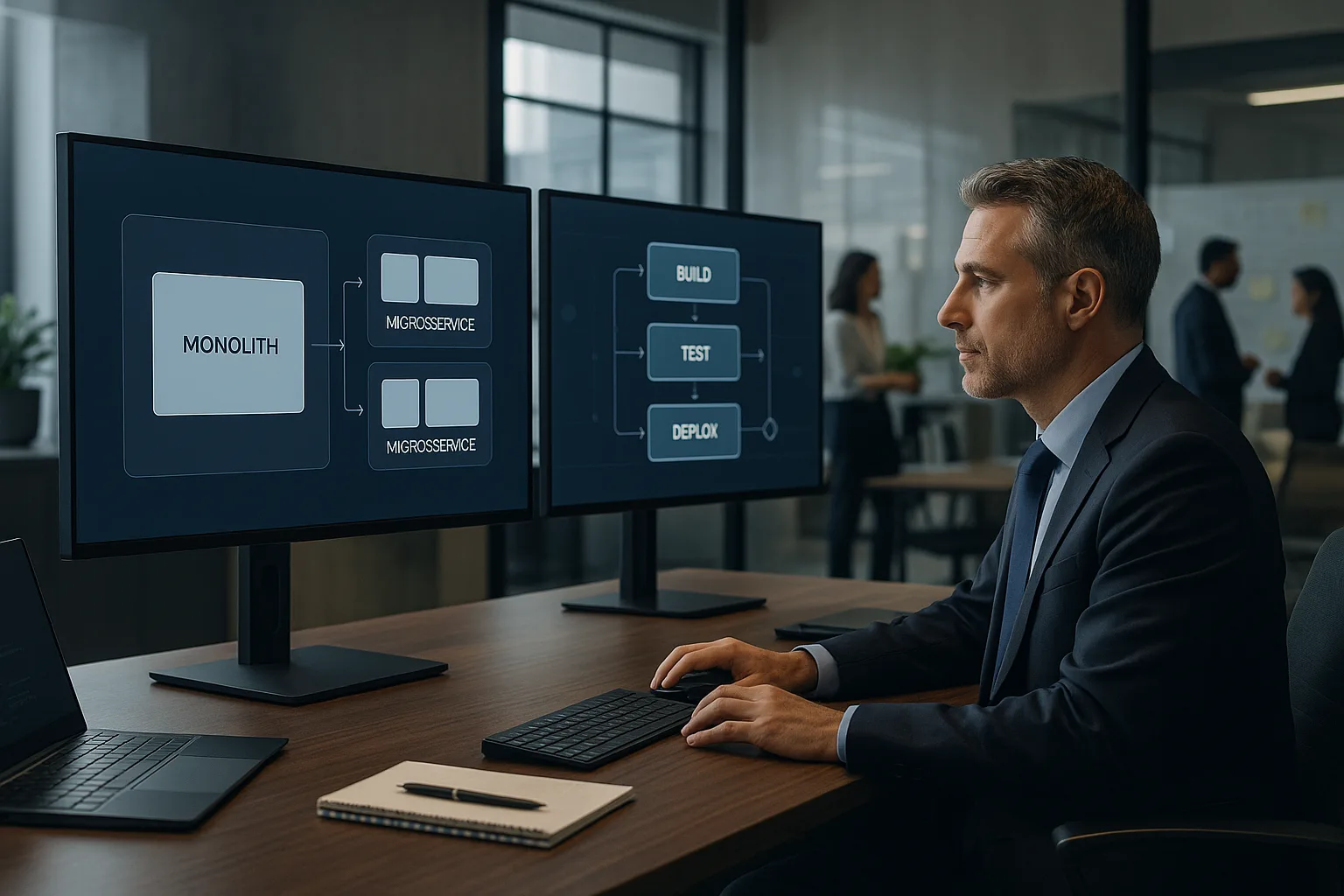
Decomposition means splitting the monolith into smaller, manageable units—typically microservices or modular components. Common approaches include:
- Strangler Fig Pattern: Gradually route specific features or endpoints to new services, leaving the monolith intact until fully replaced.
- Modular Extraction: Identify logical modules within the codebase (e.g., billing, inventory) and extract them one by one.
- API Encapsulation: Wrap parts of the monolith with stable APIs, allowing new systems to interact without direct coupling.
Each method has trade-offs. Strangler fig is typically less disruptive but requires robust routing and integration. Modular extraction demands deep codebase understanding and careful dependency management. API encapsulation can be a stepping stone but may perpetuate legacy constraints if not managed carefully.
2. Regression Safety
Modernization often fails when new defects are introduced. To reduce this risk:
- Automated Regression Testing: Build a comprehensive suite of tests—unit, integration, and end-to-end—to catch regressions early. Prioritize business-critical workflows.
- Shadow Traffic / Dual Writes: Run new components in parallel with the monolith, sending them real production traffic (read-only or dual-write) to validate behavior before cutover.
- Feature Toggles: Use toggles to enable or disable new features in production, allowing phased rollouts and quick rollback if issues arise.
Regression safety is not a one-time effort. It requires continuous investment in test coverage, monitoring, and feedback loops.
3. Deployment Control
How you release and manage changes is as important as the changes themselves. Key practices include:
- Blue-Green Deployments: Maintain two production environments (blue and green); switch traffic to the new version only when it’s proven stable.
- Canary Releases: Gradually expose new components to a small subset of users, monitoring for issues before full rollout.
- Automated Rollback: Ensure you can quickly revert to the previous stable state if a deployment causes problems.
Effective deployment control minimizes the blast radius of failures and supports rapid recovery.
Implementation Criteria: How to Evaluate and Plan Your Migration
Before starting, assess your monolith and organization against these criteria:
| Criteria | Low-Risk Migration Readiness |
|---|---|
| Automated Test Coverage | Extensive for critical paths; gaps identified and prioritized |
| System Observability | Monitoring and logging in place for both old and new components |
| Deployment Automation | CI/CD pipelines support safe rollouts and rollbacks |
| Team Skillset | Experience with both legacy and modern architectures |
| Business Stakeholder Alignment | Clear understanding of migration goals, risks, and timelines |
Gaps in any of these areas increase migration risk and should be addressed before or during the process.
Common Mistakes and Warning Signs
- Underestimating Integration Complexity: New services often require complex data synchronization and interface adaptation. Insufficient planning here can cause data drift or inconsistent business logic.
- Skipping Regression Testing: Relying on manual or incomplete tests leads to hidden defects surfacing in production.
- Big Bang Cutovers: Attempting to replace the entire monolith at once maximizes risk and reduces the ability to learn from smaller releases.
- Neglecting Rollback Plans: If rollback is not automated or well-practiced, recovery from a failed deployment can be slow and painful.
- Poor Communication: Failing to align business and technical stakeholders increases the chance of surprises and missed dependencies.
Warning signs include frequent production incidents after migrations, unclear ownership of new components, and lack of end-to-end monitoring.
Conclusion: Next Steps for a Safer Monolith Migration
Modernizing a monolith is a journey, not a single event. By focusing on careful decomposition, rigorous regression safety, and controlled deployments, organizations can migrate legacy systems with significantly lower risk. The key is to start with a clear assessment, invest in automation and observability, and adopt an incremental, feedback-driven approach.
If you’re evaluating modernization options or planning a migration, consider a technical discovery phase to map dependencies, test coverage, and operational readiness. Consult with experienced practitioners to validate your approach and avoid common pitfalls.