
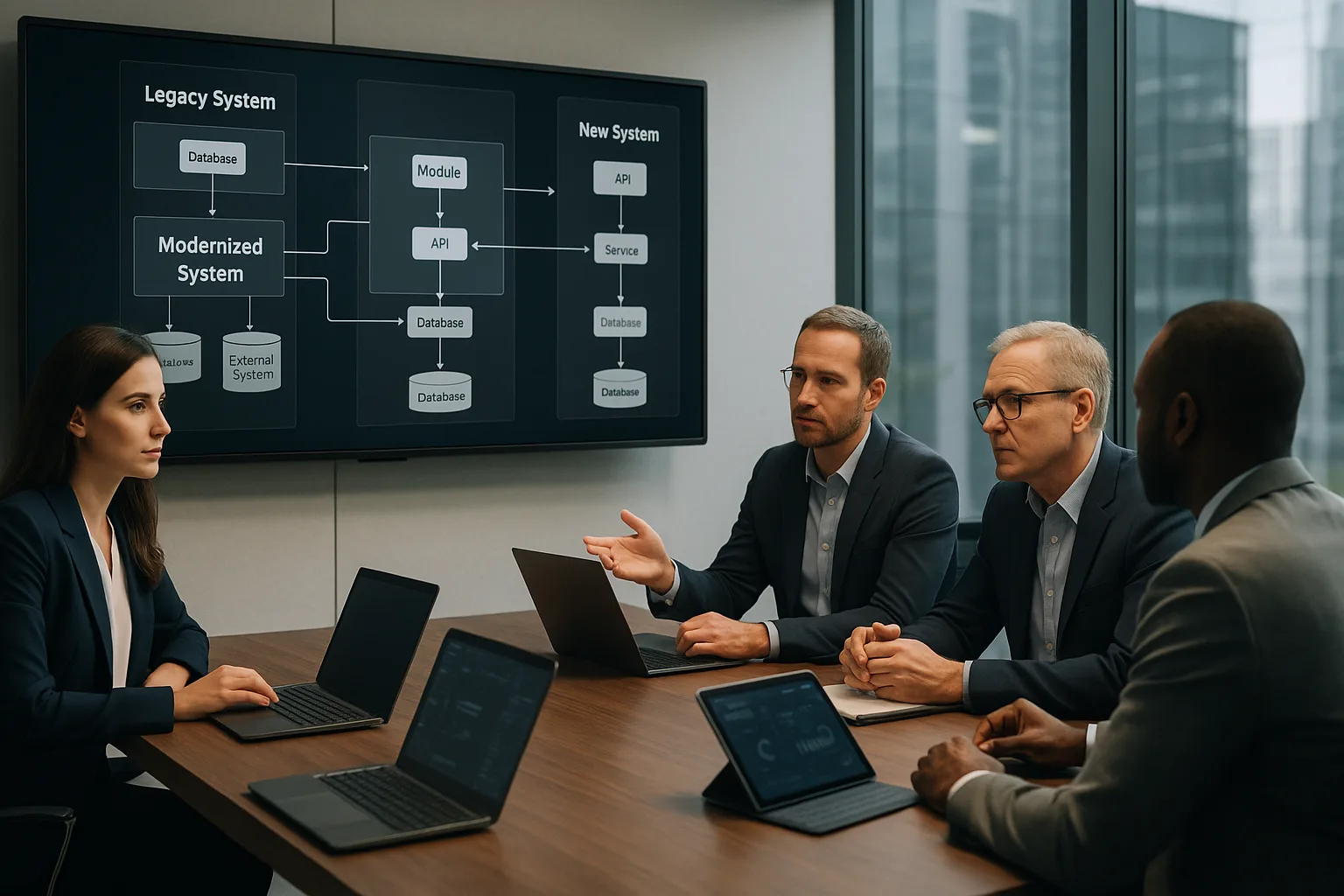
Introduction: The Realities of Legacy System Modernization
Legacy systems are the backbone of many organizations, but their aging architectures often hinder agility, scalability, and integration with modern tools. When these systems become costly to maintain or block innovation, leaders face a critical question: Should we partially rewrite, incrementally extract, or completely rebuild?
This decision isn't just technical—it impacts business continuity, operational risk, cost, and the pace of innovation. Understanding the main modernization approaches, their trade-offs, and practical evaluation criteria is essential for a successful transformation.
Why This Decision Matters: Business and Operational Impact
The choice between a partial rewrite and a full rebuild shapes:
- Business risk: How much change can your operations absorb at once?
- Cost and timeline: What are the short-term and long-term financial implications?
- Continuity: Can you afford downtime, or must the system stay live throughout?
- Technical debt: Will you eliminate, reduce, or simply relocate existing issues?
- Future flexibility: How easily can you adapt to new requirements after modernization?
Each approach—refactoring, modular extraction, the strangler pattern, or full replacement—offers a different balance of these factors. Making the right call requires understanding both the system’s technical realities and the organization’s operational needs.
Main Approaches: Refactor, Modular Extraction, Strangler Pattern, Full Rebuild
| Approach | What It Involves | Best For | Risks | Operational Impact |
|---|---|---|---|---|
| Refactor | Improving code structure without changing core functionality. Often done in-place. | Systems with manageable technical debt and clear architecture. | May not address foundational issues; limited long-term value if architecture is obsolete. | Low risk; minimal disruption. |
| Modular Extraction | Isolating and rewriting specific modules or services (e.g., extracting billing from a monolith). | Large systems with well-defined, separable domains. | Integration complexity; potential for hidden dependencies. | Medium risk; can be phased, but requires careful orchestration. |
| Strangler Pattern | Gradually building new components alongside the old, redirecting traffic until the legacy system is replaced. | Systems needing continuous operation and incremental migration. | Prolonged coexistence can increase maintenance burden; risk of integration drift. | Low-to-medium risk; enables phased transition. |
| Full Rebuild | Developing a new system from scratch, then switching over. | Legacy systems with severe limitations or obsolete technology. | High up-front cost, longer timeline, data migration risks, business disruption at cutover. | High risk; requires robust change management. |
Practical Evaluation Criteria: How to Choose the Right Path
To select the best modernization approach, assess your system and organizational context across the following dimensions:
- System Complexity: Are business rules deeply embedded, or can modules be isolated?
- Technical Debt: Is the codebase salvageable, or is it fundamentally broken?
- Business Criticality: How much risk can your operations tolerate?
- Resource Availability: Do you have the skills and capacity for a full rebuild, or is incremental change more feasible?
- Integration Requirements: Will new modules need to coexist with legacy interfaces?
- Timeline and Budget: What are your constraints for time-to-value and total investment?
Example: If a manufacturing company’s order processing system is monolithic but only the reporting module is outdated, modular extraction or the strangler pattern may offer a lower-risk, phased path. If the entire system is built on unsupported technology with no documentation, a full rebuild may be unavoidable.
Checklist: Warning Signs That Suggest a Full Rebuild
- Critical security vulnerabilities cannot be patched in the current system.
- Core business logic is undocumented or only understood by a single developer.
- Performance issues are systemic and not addressable through optimization.
- Vendor support for underlying technology has ended.
- Integration with essential new systems is impossible without major rework.
Common Mistakes and Warning Signs in Modernization Projects
- Underestimating hidden dependencies: Legacy systems often have undocumented integrations and side effects.
- Neglecting data migration planning: Data quality and mapping issues can derail even well-designed rebuilds.
- Assuming a full rebuild guarantees success: New systems can replicate old problems if requirements and processes aren’t re-examined.
- Overcommitting to "big bang" cutovers: Abrupt transitions increase operational risk and user resistance.
- Failing to align stakeholders: Lack of buy-in from business and technical teams can stall or sabotage progress.
Conclusion: Next Steps for Leaders Considering Modernization
There is no universal answer to the partial rewrite versus full rebuild question. The right approach depends on your system’s architecture, your business’s appetite for risk, and your operational realities. Start with a thorough assessment, involve both technical and business stakeholders, and favor phased, testable changes where possible.
If you’re evaluating legacy modernization options, consider consulting with experienced practitioners who can help you identify hidden risks and design a roadmap tailored to your context. Thoughtful planning and clear-eyed evaluation are the best safeguards against costly missteps.