
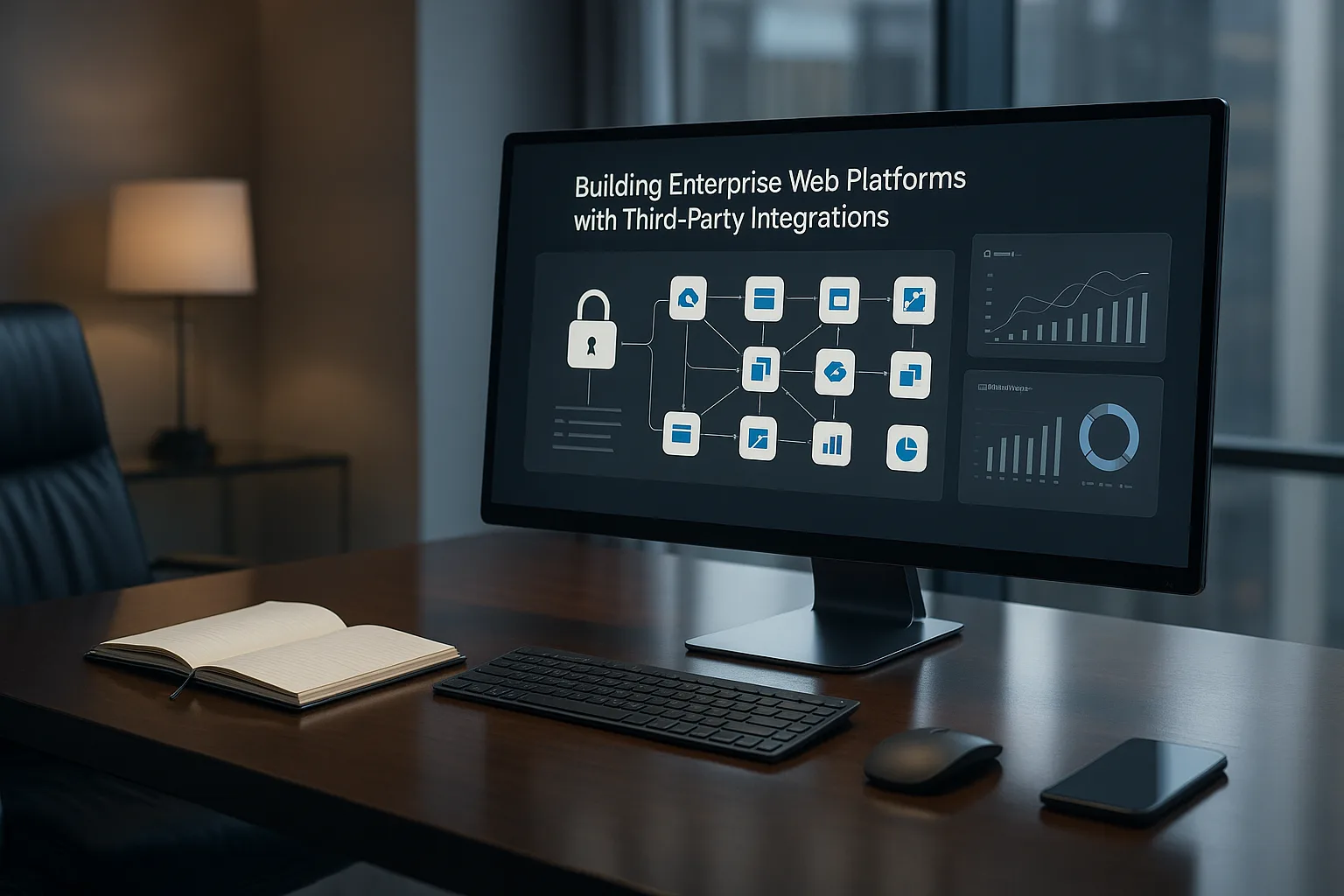
Understanding the Operational Context of Enterprise Web Platforms
Enterprise web platforms have evolved far beyond static portals or simple business apps. Today, they often serve as the connective tissue between internal systems, external partners, and a growing ecosystem of third-party SaaS products. Whether you’re building a customer-facing portal, a B2B integration hub, or a digital operations backbone, the ability to securely and reliably integrate with third-party services is now a core requirement—not a luxury.
These integrations introduce new layers of complexity: authentication schemes, data flow orchestration, error handling, and ongoing maintainability all become critical to daily operations. Decisions made during architecture and implementation will directly impact security posture, business agility, and operational cost for years to come.
Why Third-Party Integrations Matter in Enterprise Platforms
- Expanding Capabilities: Integrations allow enterprises to leverage best-in-class tools for payments, analytics, messaging, compliance, or industry-specific functions—without reinventing the wheel.
- Process Automation: Automated data flows between systems reduce manual effort, eliminate rework, and enable real-time decision-making.
- Business Agility: The ability to connect (or swap) third-party services quickly supports evolving business models and regulatory requirements.
- Risk Concentration: However, every integration is a potential point of failure, security risk, or technical debt if not managed with discipline.
For example, a retail enterprise platform might integrate with payment gateways, tax calculation APIs, supply chain partners, and customer identity providers. Each link in this chain requires careful handling to ensure the platform is secure, compliant, and reliable under real-world conditions.
Main Approaches, Trade-Offs, and Risks
1. Authentication and Authorization
Third-party integrations often require robust authentication—ranging from API keys and OAuth2 tokens to mutual TLS. Choosing the right approach depends on the sensitivity of the data, the trust model, and the operational context.
- API Keys: Simple but lack fine-grained access control. Risk of accidental exposure.
- OAuth2/OIDC: Industry standard for delegated access and single sign-on. More complex to implement but improves security and user experience.
- Mutual TLS: Highest assurance, but operationally heavier—best for critical B2B integrations.
Warning: Inadequate key or token management is a leading cause of breaches. Rotating secrets, monitoring usage, and enforcing least-privilege access are non-negotiable.
2. Data Orchestration and Synchronization
Integrations require data to flow between systems—sometimes in near real-time, sometimes in batches. The orchestration approach affects latency, consistency, and error recovery:
| Approach | Pros | Cons | Typical Use Cases |
|---|---|---|---|
| Real-Time API Calls | Immediate feedback, up-to-date data | Higher coupling, sensitive to downtime | Payments, authentication, inventory checks |
| Asynchronous Messaging | Decoupled, resilient to spikes and outages | Eventual consistency, more complex error handling | Order processing, notifications, workflow triggers |
| Scheduled Batch Jobs | Efficient for large data volumes | Data may be stale; recovery can be slow | Reporting, nightly reconciliations |
Choosing the wrong orchestration method can lead to data mismatches, bottlenecks, or operational surprises—especially as business volume grows.
3. Resilience and Error Handling
Third-party APIs are outside your direct control. Network outages, rate limiting, or upstream changes can break integrations. A resilient platform must:
- Implement retries with exponential backoff, but avoid infinite loops.
- Gracefully degrade functionality if a dependency is unavailable (e.g., queue transactions for later processing).
- Alert operators to persistent failures, not just log them.
- Monitor for API contract changes and deprecations.
Trade-off: More resilience mechanisms add complexity and maintenance overhead, but skipping them creates operational fragility.
4. Maintainability and Long-Term Cost
Every integration is a living dependency. Over time, APIs change, vendors evolve, and business needs shift. Sustainable platforms:
- Abstract integration logic behind clear interfaces or service layers.
- Document integration contracts and error scenarios.
- Automate regression testing of integration points.
- Budget for ongoing maintenance—not just initial build cost.
Neglecting these aspects can turn integrations into hidden liabilities that slow down future change or create security exposures.
Practical Implementation and Evaluation Criteria
When planning or evaluating an enterprise web platform with third-party integrations, consider the following criteria:
- Security Posture: Are all integrations authenticated using industry best practices? Is sensitive data encrypted in transit and at rest?
- Auditability: Is every integration call logged with enough detail for troubleshooting and compliance?
- Scalability: Can the integration architecture handle growth in transaction volume without bottlenecks?
- Change Management: How are API version changes, deprecations, and new requirements handled?
- Operational Monitoring: Are failures detected and surfaced to the right teams in real time?
- Vendor Dependency Risk: Is there a plan for service outages, vendor discontinuation, or migration to alternatives?
- Cost Model: Are you monitoring not just direct API usage costs, but also the operational overhead of maintaining integrations?
Evaluating platforms or partners against these criteria can help avoid costly surprises and ensure a foundation for long-term success.
Common Mistakes and Warning Signs
- Hardcoding Credentials: Storing API keys or secrets in source code or configuration files without rotation.
- Lack of Error Handling: Assuming third-party APIs will always be available or return valid data.
- Over-Coupling: Building business logic too tightly around a specific vendor’s API, making future migration difficult.
- Ignoring API Rate Limits: Failing to handle throttling gracefully, leading to service disruptions.
- Insufficient Monitoring: Relying on logs instead of proactive alerts and dashboards for integration health.
- Underestimating Maintenance: Treating integrations as “set and forget” rather than ongoing operational responsibilities.
Spotting these issues early—whether in your own platform or a vendor’s offering—can prevent outages and security incidents.
Conclusion: Next Steps for Building Resilient, Maintainable Integrations
Enterprise web platforms with third-party integrations are now the norm, not the exception. The real differentiators are resilience, maintainability, and operational transparency. Whether you’re evaluating a new platform or modernizing an existing one, prioritize:
- Secure authentication and authorization for every integration
- Thoughtful data orchestration strategies based on business needs
- Robust error handling and proactive monitoring
- Clear documentation and abstraction for long-term maintainability
If you’re planning a new project or assessing your current integration landscape, consider a technical review or consult with experts who have navigated these challenges at scale. The right foundation can save years of future rework and risk.